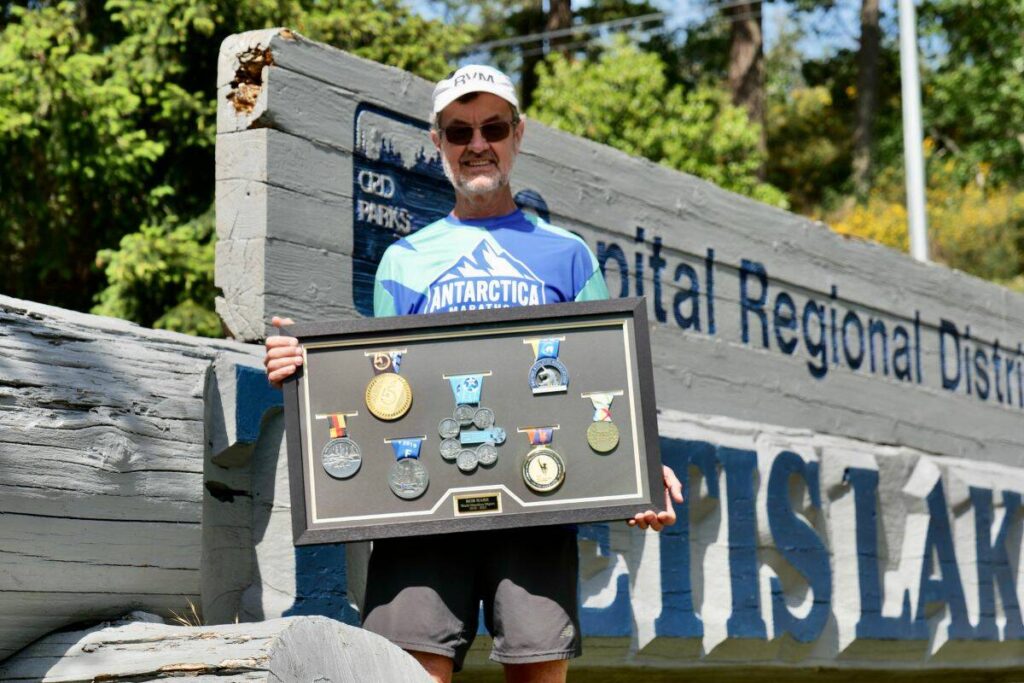
Most people come back from Antarctica with photos. Rob Hare came back with a marathon medal.
In March, the 68-year-old Langford runner completed the Antarctica Marathon on King George Island, adding another chapter to a running journey that has taken him all across the globe.
“There were penguins on the beach near the start-finish line,” Hare recalled with a laugh. “And humpback whales would come up right in front of the zodiac. It was spectacular.”
The trip was never just about the race itself.
“The Antarctica adventure was the big deal,” he said. “Going ashore and wandering around in a penguin colony, seeing glaciers and icebergs and whales every day. That was the part that really sticks with you.”
Runners tackled muddy service roads connecting Antarctic research stations as temperatures hovered around freezing, with sleet and snow blowing through sections of the course.
“It was kind of a trail race,” Hare said. “Hilly, muddy, rugged. You had to be self-supporting, too, so I carried my own hydration and nutrition because there were no aid stations.”
The course consisted of six out-and-back loops, and Hare crossed the finish line in 5:08:06, placing 23rd overall out of 102 runners while finishing third out of 14 competitors in the men’s 60-69 division.
“It wasn’t a very interesting route,” he admitted. “But you just sort of say, ‘Get across the finish line, get the medal, tick off another continent.’”
Antarctica is just the latest stop in what has become a life-changing pursuit. Hare only started running seriously in the early 1990s. Before that, he describes himself as overweight, sedentary and a smoker.
“I looked at myself in the mirror one day and thought, if you don’t do something with your life, you’re heading down a bad road,” Hare said.
Watching his father undergo quadruple bypass surgery after decades of smoking became a turning point.
He started small, running once or twice a week before entering the Garden City 10K in 1993. From there, the distances grew. Half marathons turned into marathons, then triathlons, trail races, and eventually Ironman competitions.
“You don’t really notice it happening,” Hare said. “You run with people who rave about races they’ve done, and you think, ‘Maybe I should try that too.’”
Retirement from his career as a hydrographer, helping chart the sea floor for safe navigation, only deepened his connection to the sport.
“I’m no longer that person who worked,” Hare said. “I’m now the person who helps people get ready for their first marathon.”
Hare has spent years leading Front Runners clinics while also serving as race director of the Bazan Bay 5K, a role he recently stepped away from after a decade.
But Hare kept finding new finish lines to chase.
His first massive global undertaking was the Abbott World Marathon Majors, a distinct six-race circuit completely separate from his current continental adventures.
After qualifying for the Boston Marathon through the Victoria Marathon in 2016, Hare completed Boston in 2018 before adding Chicago, Berlin, New York, Tokyo and London to earn the coveted Abbott Six-Star Medal in 2025.
His fastest finish among the six majors came at the Chicago Marathon in 2019, where he crossed the line in 3:54:59.
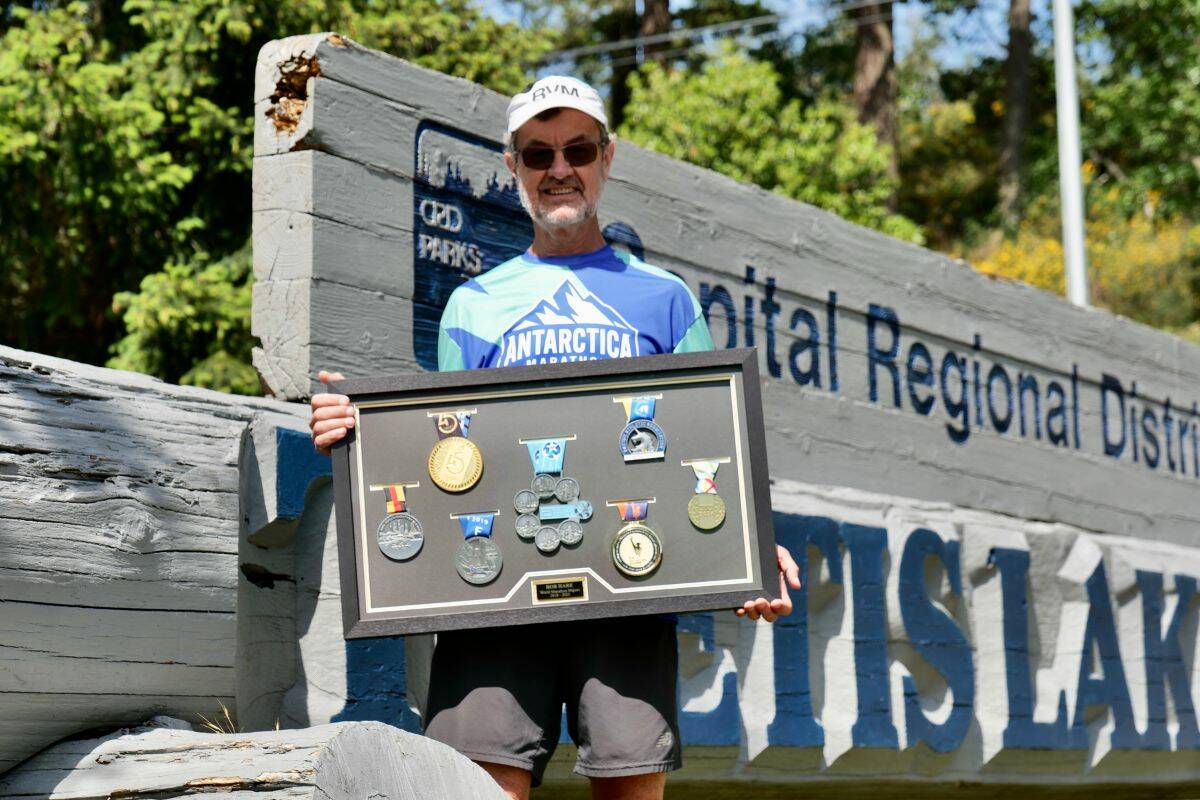
After finishing races in Boston, Chicago, New York, Berlin, Tokyo and London, Rob Hare brought home this exclusive Six-Star Medal in 2025. (Tony Trozzo/Goldstream Gazette)
“It really became a seven-year journey,” he said. “Every race had something different about it.”
Boston brought brutal weather. Chicago surprised him with its architecture and food. Tokyo stood out for its culture and cuisine.
Many of those races also became opportunities to explore the world alongside his wife, Jan, who travels with him to nearly every marathon.
“We try to turn the marathon into a destination vacation,” Hare said. “When we did Berlin, we spent a month in Germany. New Zealand was close to a month too.”
“She’s my biggest fan.”
London became part of a larger journey through Ireland, while New York included visits to the Statue of Liberty, Broadway and the World Trade Center memorial.
“Each city has something interesting about it,” Hare said. “But the countries they’re in, too. We try to spend time getting to know the places.”
With the six World Marathon Majors officially crossed off his list, Hare set a brand new goal to run a marathon on all seven continents. That is what brought him to the ice of Antarctica, and his next challenge is already around the corner.
In June, the Hares will head to South Africa for the Big Five Marathon, an event held directly through the Entabeni Game Reserve.
“They have to go and sweep the course before they let us start the race to make sure there are none of the Big Five near the racecourse,” Hare said. “The Big Five are lion, leopard, elephant, rhino and buffalo.”
Even once the course is cleared, heavy safety precautions remain in place.
“There are rangers stationed along the route with rifles in case something gets close,” he added.
Then came the punchline.
“I can outrun a penguin,” Hare said. “Not sure I can outrun a leopard.”