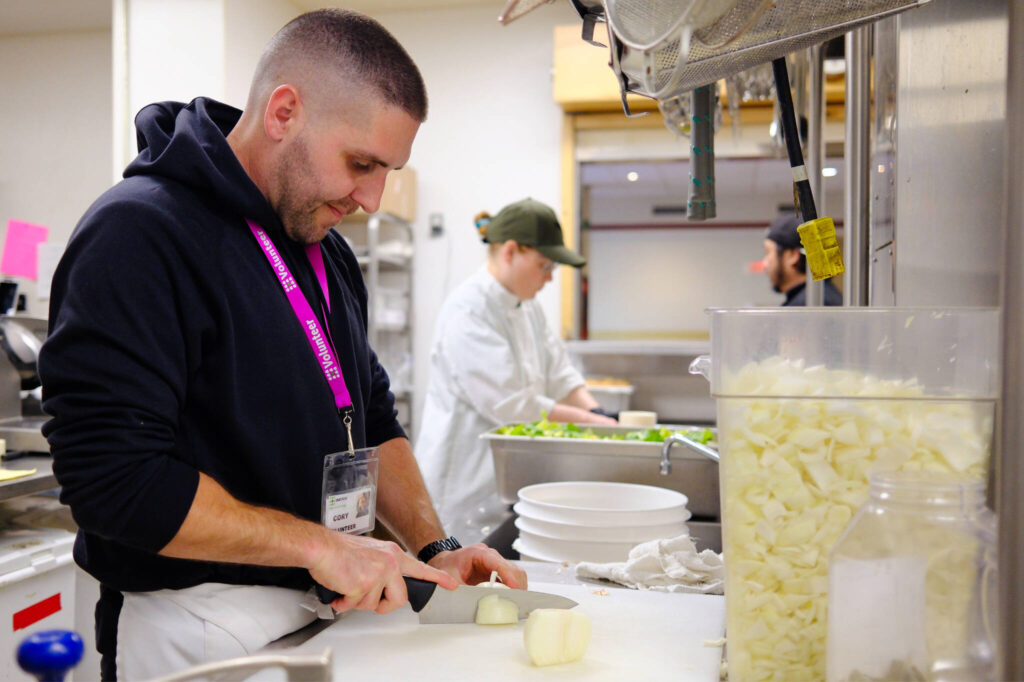
Cory Hage stands with his back slightly curved, a sharp chef’s knife in hand. His eyes are fixed on one thing: cutting onions. With steady strokes, he slowly fills an eight-quart container with large dice. This marks his first day volunteering at Our Place Society’s kitchen, helping staff prepare Salisbury steak for lunch later in the week.
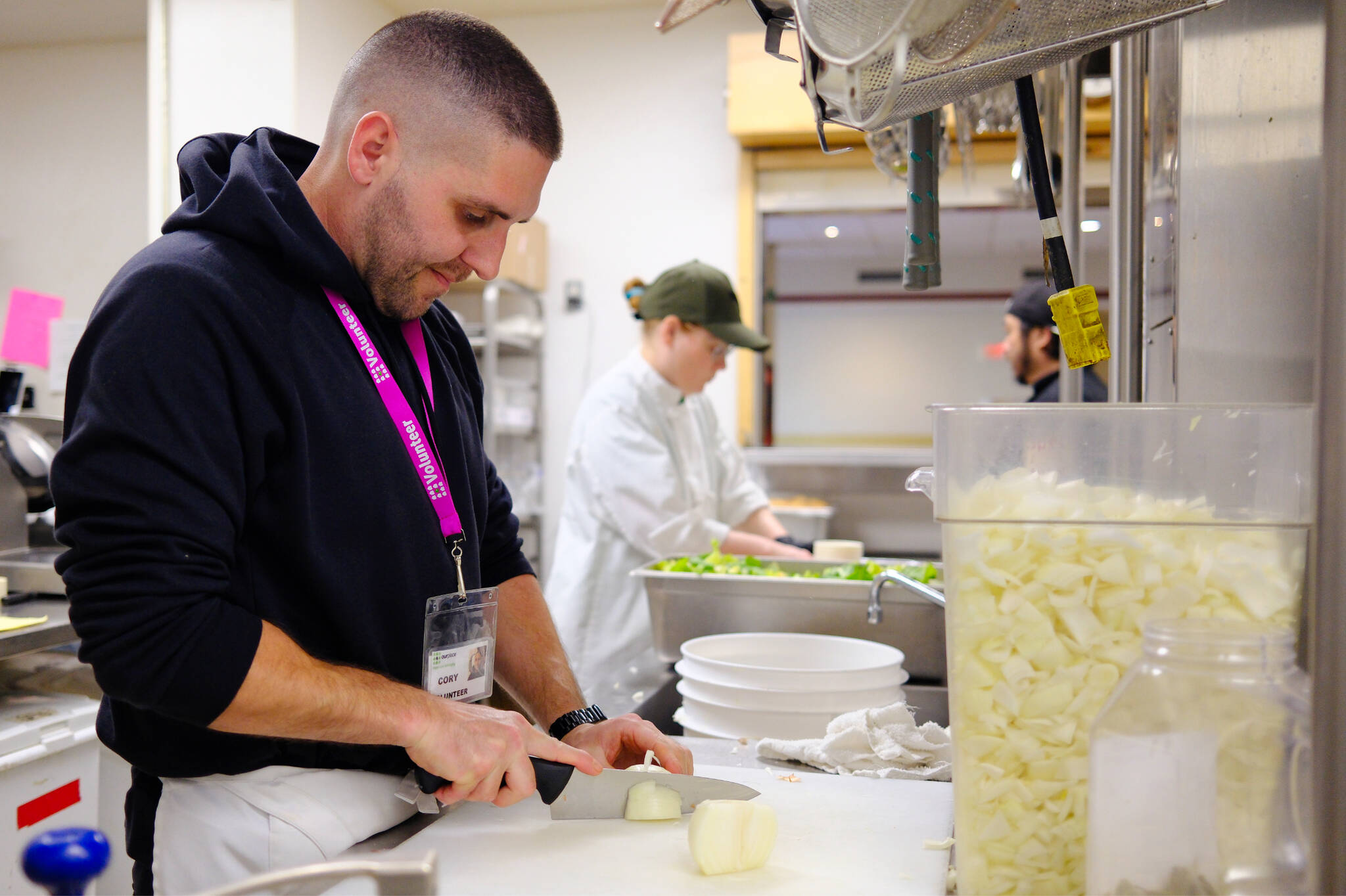
In his free time, Cory Hage volunteers as a prep cook in Our Place Society’s kitchen. (Olivier Laurin/Victoria News)
Shortly before noon, the chef shakes Hage’s hand for his work as he takes his leave, hanging his apron on the way out.
Once outside the community centre, he glances at the van he drives as Our Place’s shipper-receiver before heading into the laundry room where he cleans the sheets used daily at the overnight shelter. There, he stacks two milk crates to sit on, away from the nearby hustle and bustle of Pandora’s 900 block.
Sitting in quietude, the 40-year-old man recounts that his past life was far from exemplary. Until recently, he described it as a hazy, vicious cycle of instability set in motion by a troubled childhood. Characterized by countless moves across the country, school transfers, evictions, stints in shelters and time with child protective services, this early-life “chaos” eventually led to drug dealing and two incarcerations.
But now, celebrating nearly two and a half years of sobriety, Hage has turned his life around, channeling his turbulent past into a force for good, choosing to give back to the community that helped him rebuild his life.
Troubled waters
Hage was born in Saint John, N.B., to a musician father, which prompted the family to move frequently. After a short-lived stay in the Maritime province, the Hages moved westward to Toronto, “down to the ghettos,” bouncing between the city’s most impoverished neighbourhoods.
After his parents split up, Hage was sent back with his grandmother in New-Brunswick until he was 10 years old before eventually returning with his brother to his father’s place back in Ontario.
But for Hage, this wasn’t a welcomed change as he described his father as an “abusive and shady” character.
“He would just like to get drunk and high,” he said. “That’s why my brother and I always wanted to be around my mom and stepdad. They treated us better and they got us presents for Christmas. They just tried their hardest to always provide for us.”
That year, Hage said that his mom “stole” both him and his brother, hoping to offer them a better life.
“She didn’t have custody of us at the time, but she just took us and we hopped on the bus,” he said. “We came all the way to Victoria because she had her sisters out here.”
But after what Hage described as a dismal string of bad luck, his family had to head back east.
“One night we had to pack up all our things with our cat and two dogs,” he said. “We stopped in every city on the way back, trying to make money, doing window cleaning and odd jobs to keep the gas tank and our bellies full.”
Back in Ontario, Hage moved with his dad to a farm “in the middle of nowhere.”
“To tell the truth, I just shut right down,” he said. “I just stopped caring about anything. I went into a little bubble of safety where I just tried to keep myself entertained.”
Evicted once more, Hage and his father moved to a shelter in Scarborough, “the one place that would house us,” he said. But this period would be short-lived.
“My dad started selling his prescription pills when someone at the shelter ratted him out,” he said. “That’s when child protective services came in.”
Yet, unlike many would think, Hage remembers his time at a group home fondly.
“I actually really enjoyed it because I was getting fed three times a day,” he said. “I had friends there, I had my own space, they gave me an allowance every three months to buy clothing.
“There was a structure. That was the first time in my life that I had a tiny bit of stability.”
After fighting “tooth and nail” for custody of her son, Hage’s mother finally gained it and moved back to Victoria.
Now in his early teenage years, Hage attended Central Middle School. But housing was still a daily struggle. In Grade 11, he lived on a couch at a friend’s place when he was first introduced to drug dealing.
“A couple of days after moving in, my buddy takes me downstairs and shows me his dad’s secret room,” he said. “The guy was growing weed and he had bags of it already trimmed. I was looking at it like it was a gold mine.”
Having never stolen before, Hage and his friends took a handful of buds, stuffed them into their pockets and sold them at school the next day.
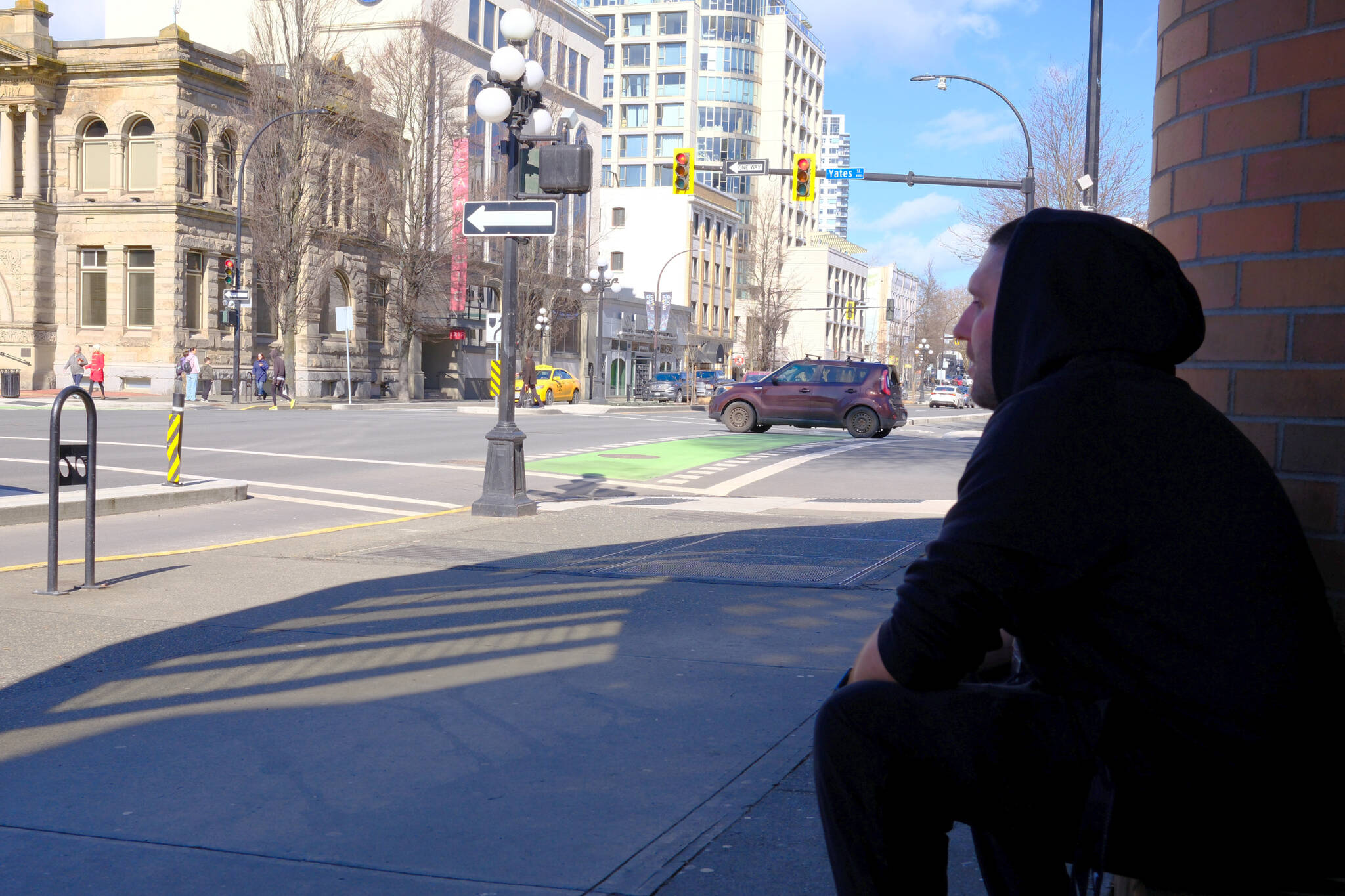
Cory Hage sits at the corner of Yates and Blanshard streets, where he hung out with friends in his teenage years, frequenting spots like the now-closed arcade Johnny Zee’s. (Olivier Laurin/Victoria News)
After making his first sales, he recalled feeling a new sense of freedom, explaining the money would go toward food and cigarettes. As it became a profitable venture, Hage began skipping school and his grades started to drop.
“I ended up being expelled,” he said. “But I didn’t really care at that point because nothing else was going on. I was homeless, living on my friend’s couch, so I thought I might as well just keep selling weed.”
Hage eventually started selling harder drugs, making more profits. On “welfare Wednesdays,” Hage could turn $50 worth of cocaine into $140 within 10 minutes.
“I was looking at all this cash in my hand and that’s what got me hooked,” he said. “It felt like a normal life for me.”
But this occupation came at a high cost.
“(I was) on the block selling every night and I would get high,” he said. “But I had that addictive personality and that’s where I failed.”
Despite a burgeoning cocaine addiction, Hage moved up the “food chain” of Greater Victoria’s underworld. Selling increasingly larger quantities, his rise came to an end when his own consumption habits began to interfere.
“I was using more than I was selling, so I became a customer,” he said. “I got to that low point where I was running around trying to rob other drug dealers.”
After a first stint in jail for a break and enter, now sober, Hage quickly slipped back into his old ways.
“I was still young and I felt like I could do things better,” he said. “I thought I could stay sober, sell drugs and stack my money this time.”
However, his addiction returned in full force, escalating from cocaine to crack and eventually fentanyl. After Vancouver dealers warned him that the drug supply was becoming increasingly toxic, with benzodiazepines appearing in the mix, Hage switched to methamphetamine. He described this period, which spanned more than a decade, as one big blur lost to addiction.
This cycle, however, would end with his second incarceration.
During a meth-fueled car ride, a simple traffic stop turned into an arrest which led to gun charges in 2022.
“I told myself, ‘I need to change my life,’” he said. “I was getting close to 40, I had nothing and lost everything.”
Remembering a promise he made to his mother after she passed in 2018, Hage took his future into his own hands and decided to change the script.
Around the same time, Hage’s lawyer presented him with the option of a spot at New Roads, Our Place’s long-term residential treatment facility, which had recently opened.
“I went full tilt into it,” he said. “I didn’t stop and I kept myself busy every single day.”
This stay provided the stability he needed to breathe, rebuild himself, and flourish.
“I genuinely wanted to better myself,” he said. “I did everything I set my mind to while I was there. Every goal I made for myself, I accomplished. I graduated from the place with honours and I was an inspiration to other people there.”
After completing the program, Hage had a single goal: to lead an honourable life, free of drugs and crime.
After connecting with a facility manager at Our Place, he handed in his resume and “hoped for the best.” That same week, he got a job as a shipper-receiver, which he still happily does to this day.
“This life is more glamorous to me now,” he said. “That’s the life I want. I’m getting everything I need for the first time in my life; I have stability, I’m making my own money and I’ve been able to save.”
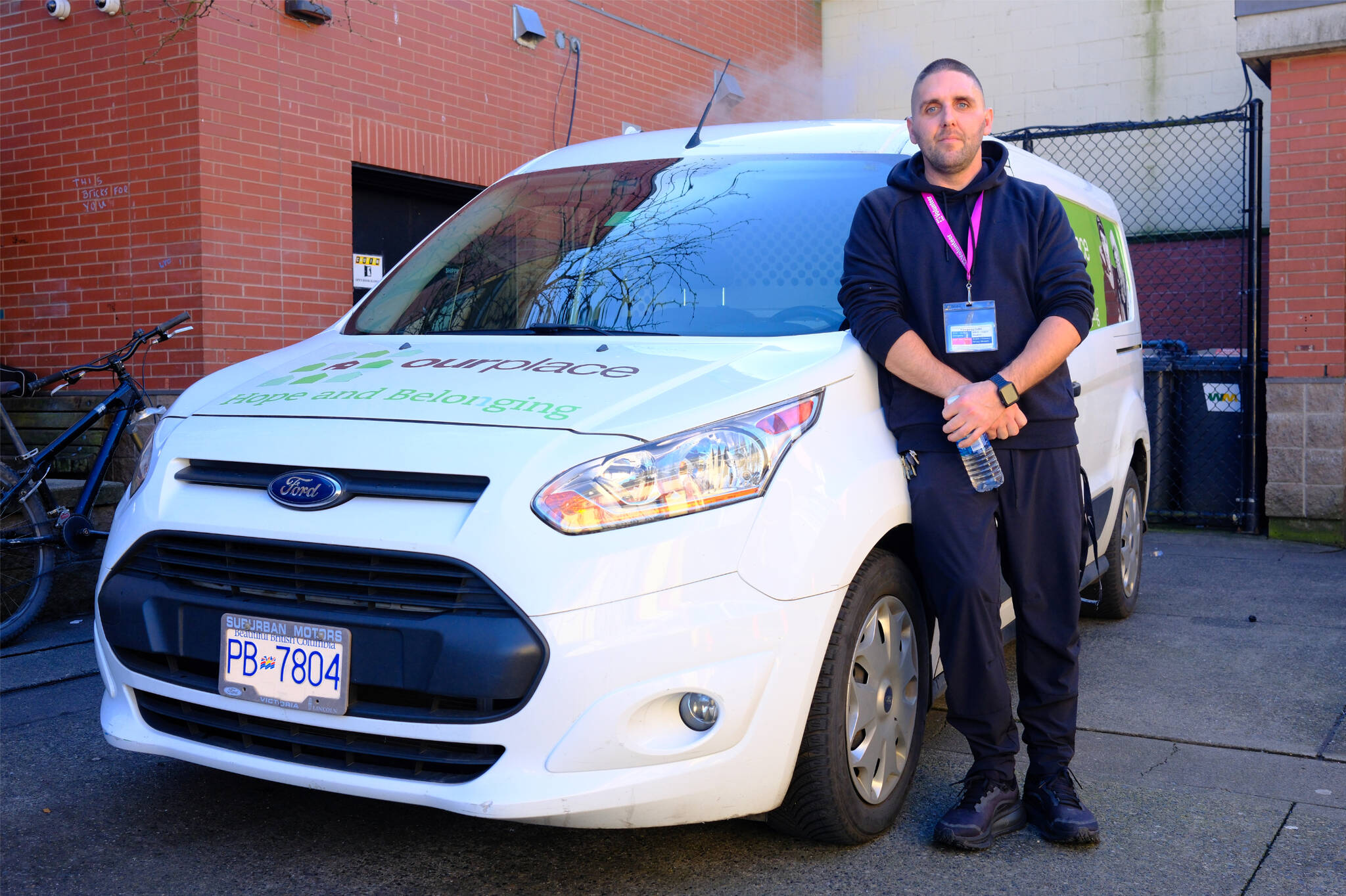
Hired as Our Place’s shipper-receiver, Cory Hage drives the non-profit’s van across Greater Victoria to collect donations and deliver warm meals. (Olivier Laurin/Victoria News)
With time on his hands and a clear mind, Hage began looking back at his past and started to understand the patterns that shaped a life he described as “pure chaos.”
“I didn’t have good communication skills because I never really had conversations with people growing up,” he said. “I couldn’t pay attention in class because I was worried about bills and rent when I was 10 years old.”
And dealing drugs, Hage explained, simply started as a means to an end, initially seeking to fulfill basic needs, before devolving into a destructive occupation.
With his past behind him and his eyes set on the future, Hage hopes to one day have his family, maintain his sobriety, and contribute to healing the community he now works for.
“I’m so proud of myself for everything I’ve accomplished,” he said. “I didn’t ever think I could get to this point in life. I’m just so grateful for everything I have now.”
And to anyone still battling addiction, Hage shared some words of hope.
“If I could do it, anybody can do it,” he said. “Don’t be scared to ask for help and don’t think that you’re going to burden someone by asking them for a helping hand.
“It might take a long time, but just have patience and trust the process. I’m living proof that success happens.”