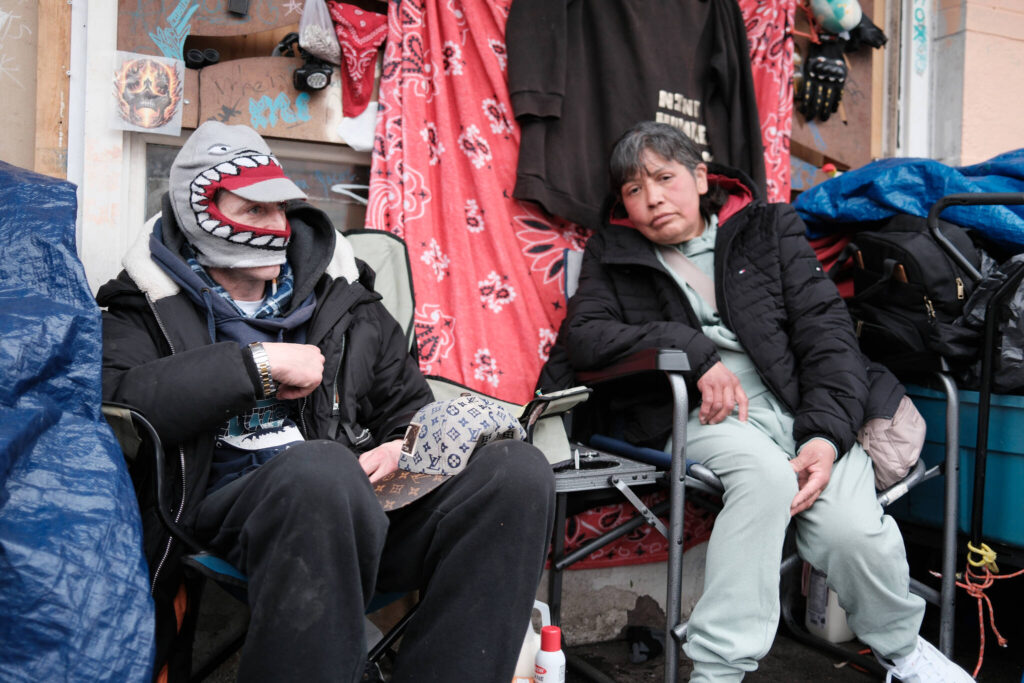
Donna, Artemis, and Jeziah sit in front of Pandora’s Chicken World on the 900 block. Their eyes, stern and lost in thought, stare at the sidewalk. Numbed with pain, they speak only a few words.
“Raw” is among the descriptors they choose to sum up their state of mind a few days after their friend, Jacob Vance, died on Feb. 27.
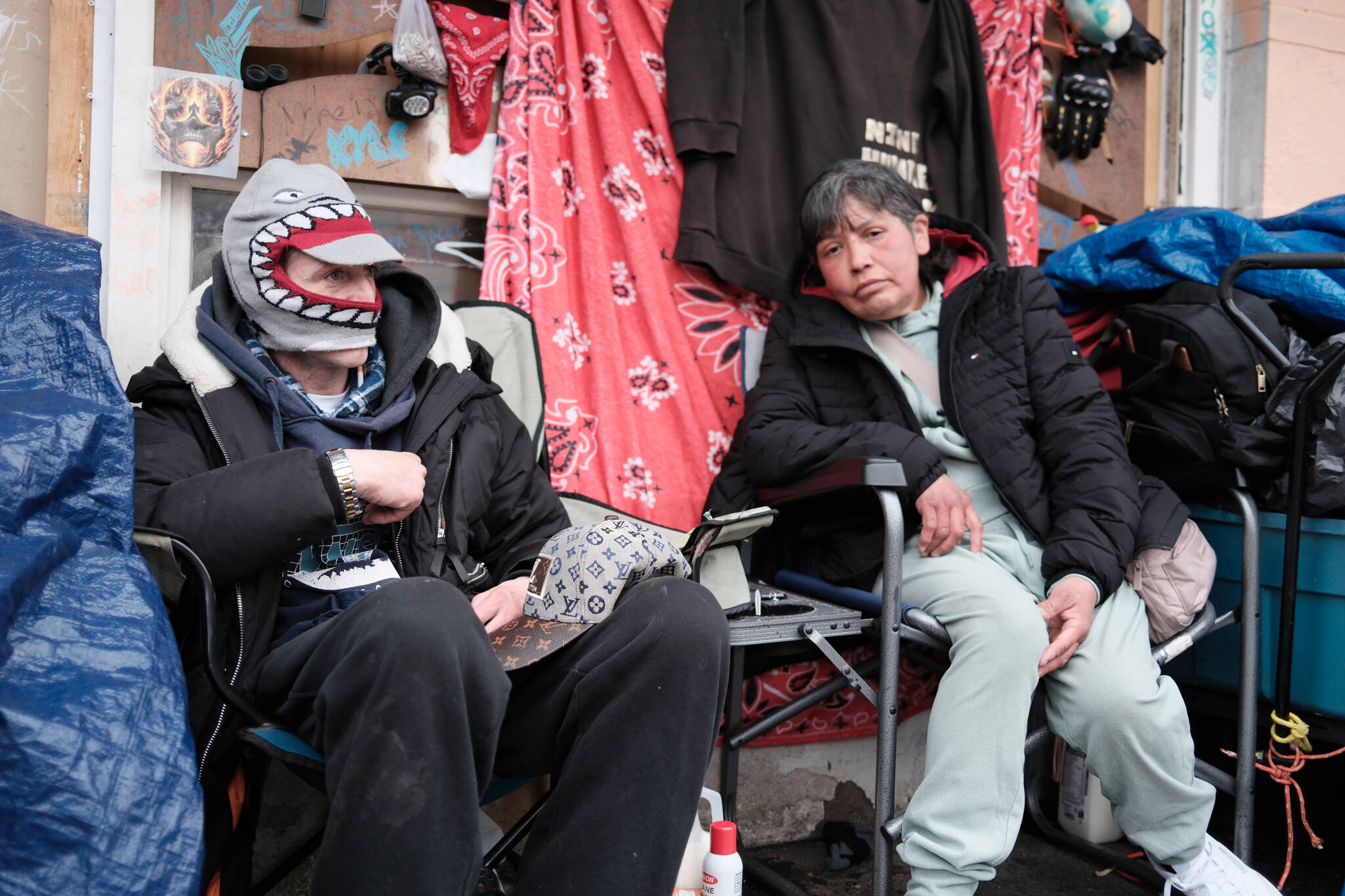
Donna (right) and Jeziah reminisced about the impact Jacob Vance, 32, had on them and the community before his death in late February. (Olivier Laurin/Victoria News)
As if standing guard over the memory of the 32-year-old man, the trio sits metres away from the spot where they last saw him, struggling to fathom their friend’s passing.
Although opioid overdoses have claimed many lives in Greater Victoria, Donna explained that Jacob died of an asthma attack. She explained his condition had worsened in recent months following an infection he never fully recovered from, but argued that a street sweep by Victoria bylaw officers and police was the coup de grâce.
“They’re only supposed to take stuff that’s wet or dirty, but that one time, when Jacob went to the hospital, I packed his things up and they took his asthma inhalers,” said Donna. “He probably would have been here if they didn’t take his puffers.”
In the morning, as Jacob drew his last breath, Donna was by his side.
“He went running around yelling and asking people for an asthma puffer,” she said. “By then, he was already down on the ground. When the ambulance came here, they weren’t doing anything. They were just telling us to be quiet.
“I was shouting, ‘Jacob come back,’ and other people were doing the same thing.”
Hours after his passing, friends and loved ones set up a small memorial. A shrine quickly took shape, made up of art pieces, his BMX bike, a pair of Nike shoes he cherished, and graffiti immortalizing his passage on earth.
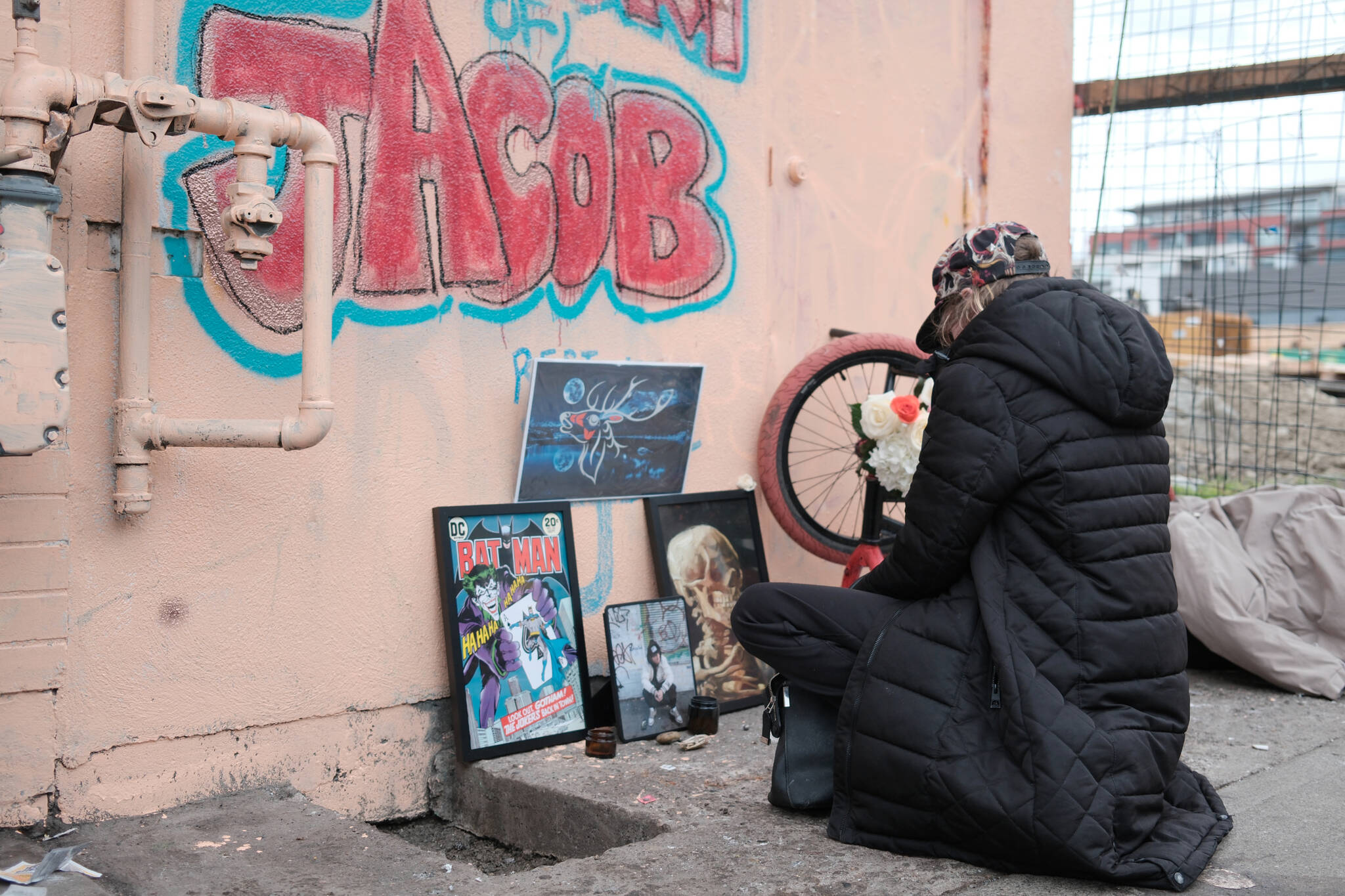
Artemis, a good friend of Jacob Vance, reflects on her loss at a small memorial created in his name. (Olivier Laurin/Victoria News)
“He always put himself out there to help others,” she said. “I lived out here with him, and he always made sure that I had a heat source so it would be warm, and if it rained, he’d put tarps over so I wouldn’t get wet. He was a real trooper.
“He made sure that everyone was looked after.”
Living on the streets, at the mercy of the elements and bylaw crackdowns, Donna is still searching for a way to grieve. “I don’t know how to deal with it really, except to do drugs,” she said.
While this death is a tragedy in itself, it’s one that has repeated 14 other times since the beginning of 2026, according to local outreach groups. Nearly 1,300 people died in the Capital Region alone from 2016 to 2025, according to the B.C. Coroner’s Service – a number that swells to over 18,000 at the provincial scale.
Yet in mainstream media, the emphasis is often placed on numbers. Victoria News headed to Pandora in early March to hear from the street community, put faces to those figures, and remember the people behind them.
Walking nearby Donna is Lee-Anne, a Sooke resident who regularly returns to Pandora – a place she once called home – to stay connected with her “street family.” But in recent months, this community has gotten smaller.
“We all care about each other because we’re a family here, but losing four of them is hard,” she said as tears rolled down her cheeks. “I don’t know how to put it into words really.”
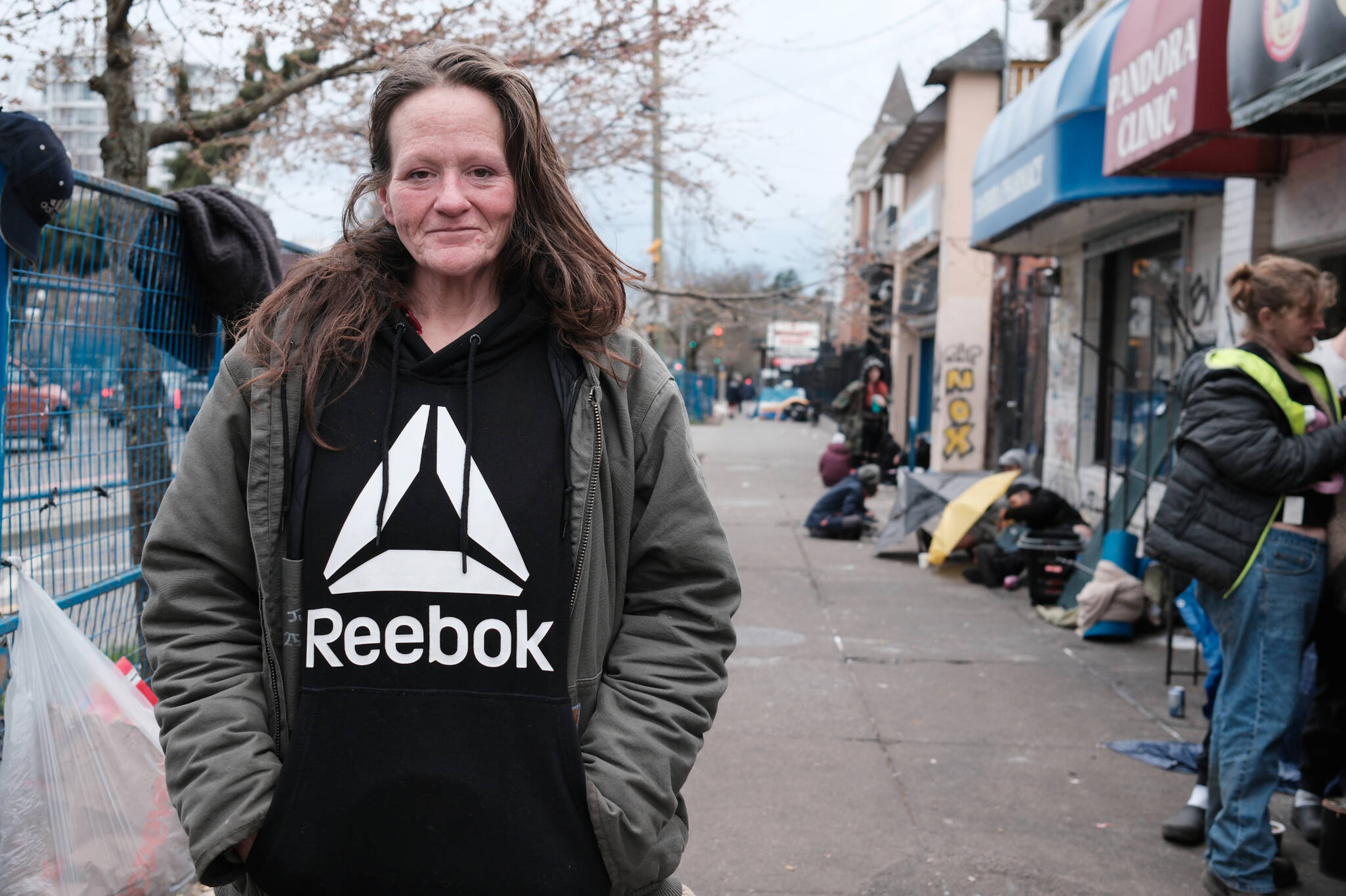
Sooke resident Lee-Anne often returns to the 900 block of Pandora Avenue to stay connected with her “street family.” (Olivier Laurin/Victoria News)
Among those were both Vance and her good friend Haley Leeworthy, who was also 32.
“When she died, it was such a shock,” she said.
Describing both Jacob and Hailey as pillars of the street community, Lee-Anne explained that life without them feels more precarious.
“They were just amazing people,” she said. “I’m gonna miss them.”
Vance and Leeworthy were among those remembered during one of the new monthly community memorials hosted by SOLID Outreach. Providing a safe space off the street for the community to grieve, the third and most recent event honoured the lives of Carrie-Anne Wishart, Dokk Chipera, Rene Vaillancourt, Thomas Hawkins and Robert Campbell Bruce.
Among the large crowd was Sierra McNee, 19, Bruce’s daughter, along with her father’s friend Roman Sencar, both seated in the front row.
“He cared a lot about everybody else,” said McNee. “That’s what drove him to pass away in the end because he didn’t end up helping himself.”
“He was putting everybody else before himself,” added Sencar. “He’d give his shirt off his back, and if you needed anything, he would help you out or try to do the best he could.”
[gps-image name=”42016483_web1_260330-VNE-Memorial-feature-PHE-1_11.jpg”]
Sierra McNee and Roman Sencar joined the third SOLID Outreach memorial held in March 2026 to celebrate the life of Robert Campbell Bruce. (Olivier Laurin/Victoria News)
McNee, who lives in Campbell River, expressed her gratitude to SOLID for organizing the event, giving her closure and a chance to meet those who knew her father.
“I never could have afforded to put something on for him myself,” she said.
With little time or space to grieve on the streets, Sencar said remembering can sometimes be a challenge in itself. Often, the only option is to “keep people in your heart.”
“They just live in your memory,” he added. “You can also keep the simplest little things, like Legos, or listen to songs that remind you of them.”
Since October, former journalist turned community advocate Jody Paterson has been documenting the lives of people on the streets. Disheartened by their lack of representation in mainstream media, she launched a project called Street Stories Victoria to bring their perspective into the spotlight.
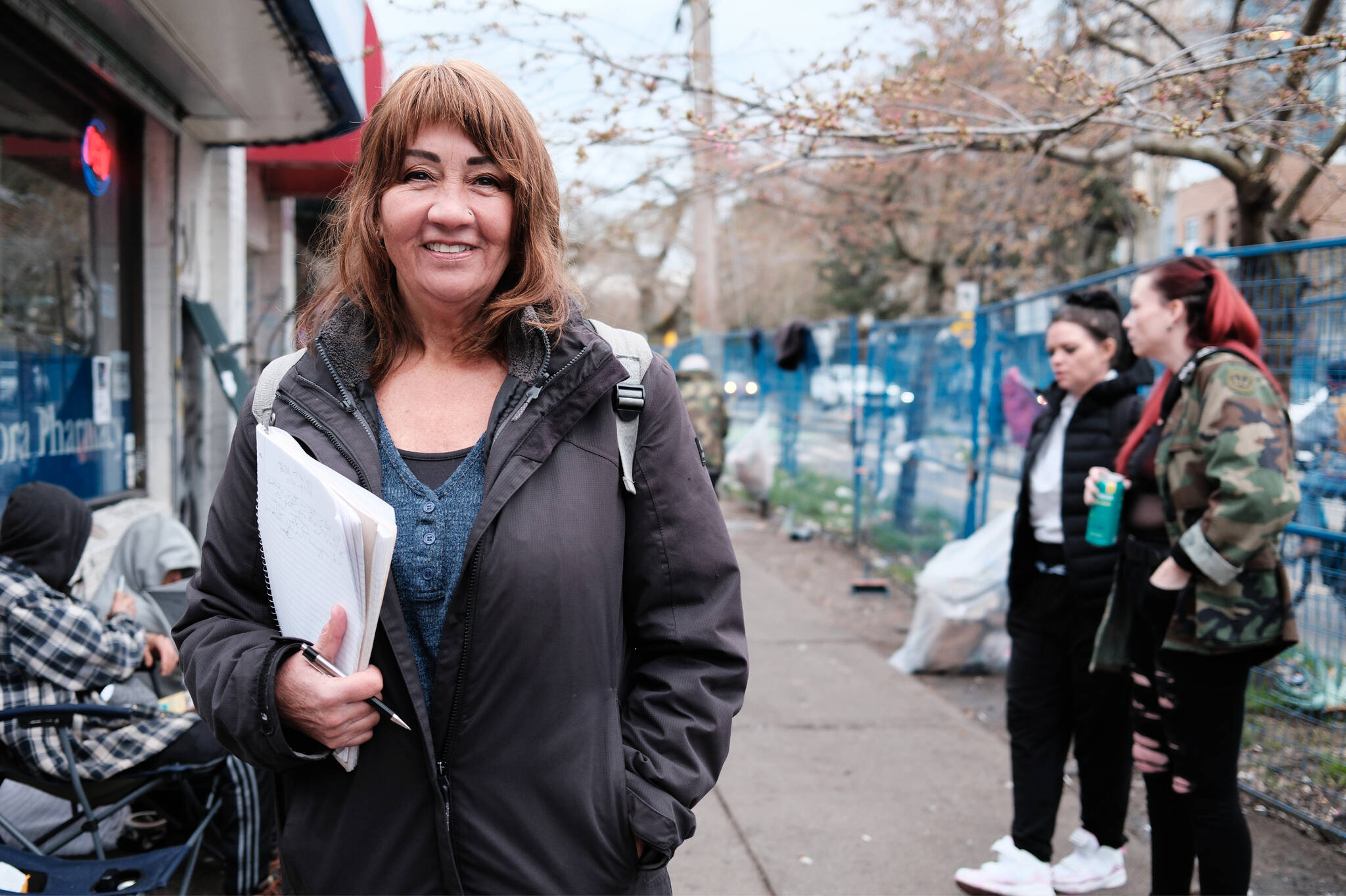
Jody Paterson poses on Pandora Avenue during an outing where she gathers testimony from members of Victoria’s street community. (Olivier Laurin/Victoria News)
After gathering nearly 200 stories, Paterson said every single person out there has experienced loss – and a lot of it.
“I talked to someone who had tattoos of all his friends who have died from the toxic drug crisis, and I couldn’t even count all of them,” she said. “He had that many.”
After witnessing this crisis firsthand and through the countless stories she has heard, Paterson said most people do not grasp the sheer scale of the issue.
“I don’t think any of us really understand how many people are dying out here,” she said. “People are losing friends and street family members literally every week. And these are people whose names are never put in the paper or any media. They don’t get a ceremony and they are most often just forgotten.”
While dealing with a death is already a challenge in and of itself, doing it on the street is a whole different story.
“I’ve been through grief with my parents and it took me a long time,” she said. “But what happens when you don’t get to go through it, and you’re always worried about who’s the next person who’s going to die?”
With death and grief nearly always part of the stories she hears, Paterson described something akin to post-traumatic stress disorder, where people suppress thoughts and feelings about an event to protect themselves. Many people interviewed by Victoria News showed this pattern, expressing numbness, detachment, or emotional disconnection, often without even realizing it.
“They can no longer allow themselves to register the pain and grief which, to me, just increases the traumas that they’ve already got,” said Paterson.
Though new to outreach work, Shaye Gray has witnessed this phenomenon all too often. Noting people’s remarkable resilience, she added that there is only so much a person can take before reaching a breaking point.
“People on the street especially need emotional support,” she said, having experienced life on the street herself. “Even though you’re very resilient for a long time… it’s eventually going to build up to a point where you don’t know how to handle things anymore, and that’s when mental breakdowns happen.”
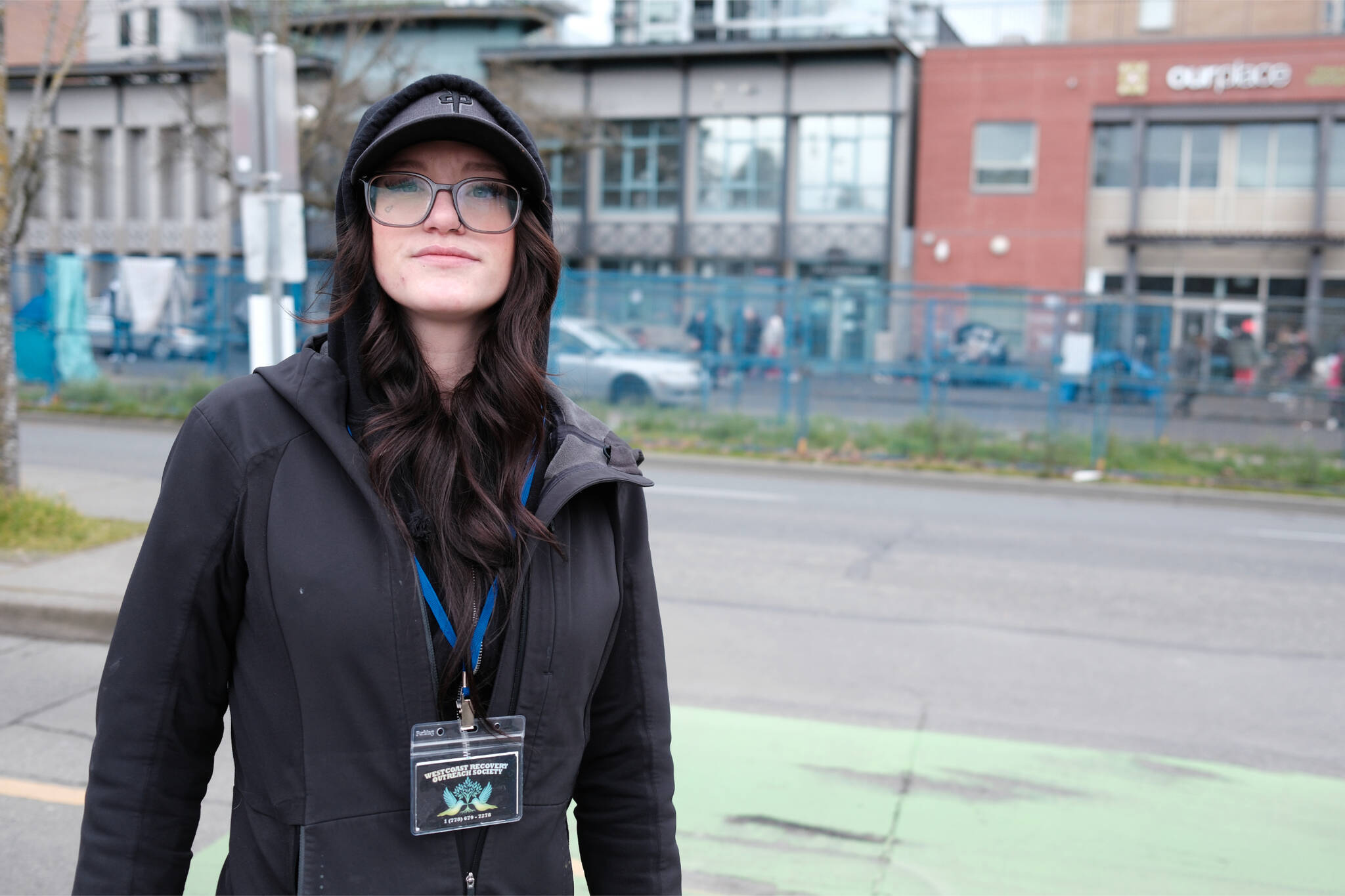
Shaye Gray works as an outreach worker for the Westcoast Recovery Outreach Society in Victoria. (Olivier Laurin/ Victoria News)
Gray said a single event, like another loss or even a rainy day, can become the last straw after long-standing grief, anger, and sadness.
While substance use may help keep pain at bay, Gray believes anyone can turn their life around and heal.
“People need to realize that dying is not their last option; help is available,” she said.
Growing critical of the government’s inaction on what she called “preventable deaths,” Paterson said that a lack of investment in housing, detox centres, harm reduction services and treatment beds has created a vicious cycle bound to repeat itself.
“We’ve really set people up for failure, and then we blame them for using drugs as we sit at home with a glass of wine,” she said. “I don’t get how people don’t feel the human toll of it all. How do you not see those people as somebody’s kids?”
A decade since the declaration of the public health emergency, Paterson argued that “virtually nothing has changed,” but hope remains.
“Having been out here, I’ve met so many groups who are trying to do something,” she said. “Everybody is trying to do more.
“There’s all this stuff happening on the ground, a little bit in isolation, but together, the power of the community can address what the politicians are not doing.”