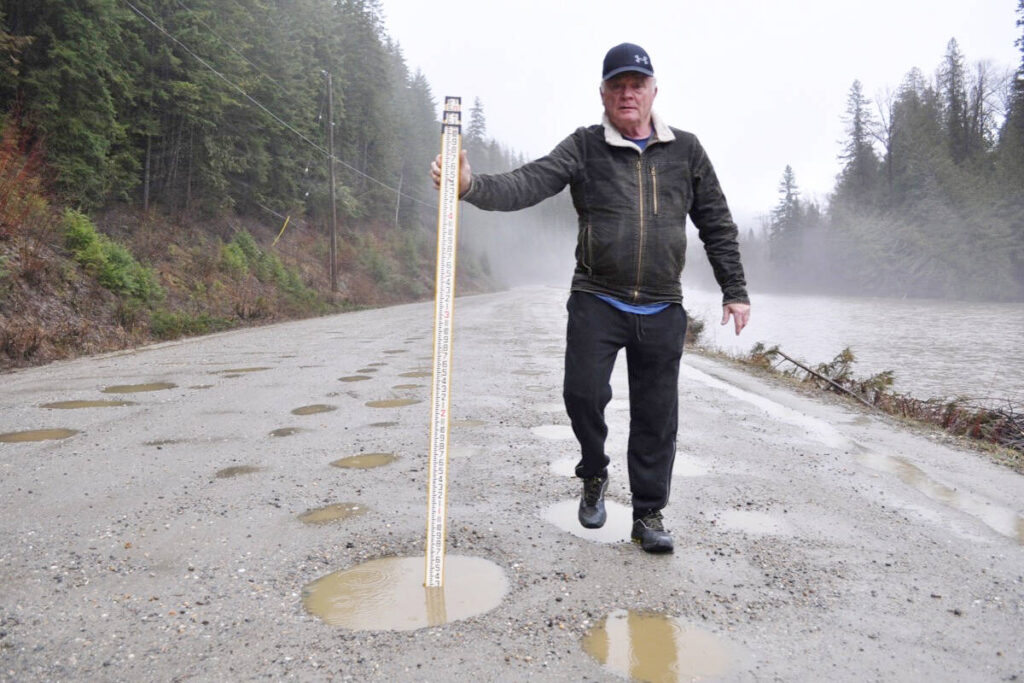
Grant Trower drove his Ford F-350 over the road towards his home as though he was navigating a minefield.
Trower wasn’t on a forest service road. An unpaved stretch of Highway 31 between Marblehead and Trout Lake, in a rural area north of Kootenay Lake, was so pocked with potholes that Trower couldn’t go faster than five km/h.
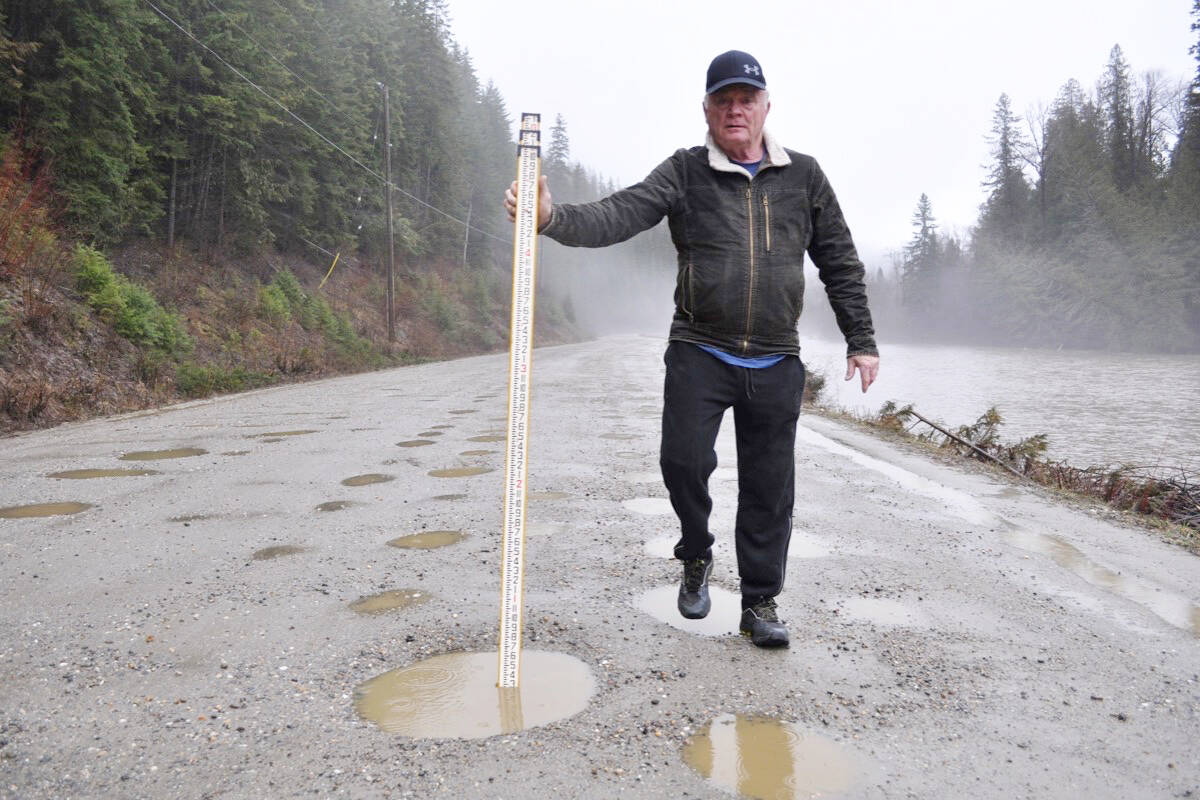
During a visit with residents on March 20, a Nelson Star reporter watched as cars swerved on both sides of the highway to avoid potholes that in some places were six inches deep. Some kept two wheels on the highway’s shoulder close to the nearby Duncan River that was raging during spring runoff.
Trower, who has lived in nearby Howser for nearly 40 years, said the highway has never been in good condition. But now it had deteriorated to a state he believes is too dangerous to drive on.
“It’s just totally completely unsafe,” said Trower. “We’ve never seen anything like it.”
Jenn Berg lives on a property north of Meadow Creek where she works at the community store. The distance between her home and workplace is just 15 kilometres, but the commute can take her between 40 minutes to nearly an hour.
It’s not just the potholes that slow Berg down. Earlier this month snow fell on the highway but wasn’t ploughed, which made her drive all the more perilous.
“Every day when I get here, my nervous system is on fire. It’s terrible.”
Regional District of Central Kootenay Area D director Aimee Watson represents residents who use the highway north up to Gerrard, which is a little over halfway to Trout Lake.
Highway 31, Watson said, is a hazardous drive for commuters. She’s also worried about what it might mean for first responders should they need to use it for an emergency.
“The state of the road this year is the worst it has ever been to the point where I’m pretty sure that a paramedic, any kind of emergency services, search and rescue with their 4×4, probably could not get up there.”
Area D is the RDCK’s least populous area. Only 1,462 people live in the region, according to the 2021 census, and of those over 1,000 are clustered in Kaslo.
The small population, Watson said, makes it difficult to argue for highway improvements. She and Kaslo Village Council once lobbied the transportation ministry to repave a section of the road up to the Duncan Dam. The work was done, but only after four years of advocacy.
“I don’t think the budgets have been in place to really address these rural communities that are more and more disincorporated from basic services. I think the thing that’s not being said by [the transportation ministry] or anyone else is that they’re not maintaining the roads to the level that they used to.”
That has led residents to feeling as though they are overlooked by the provincial government.
The highway is the only way Cari Lamoureux can commute from Howser to Kaslo for work. Like Berg, Lamoureux also drove Highway 31 the same day it snowed in March and described it as treacherous.
Lamoureux is also concerned about her child taking the school bus that has to travel Highway 31, as well as for anyone driving to the community’s transfer station that is only accessible via the road.
“We’re not a bunch of retired people up the highway there. We all have to drive and get to work. We pay taxes like everybody else.”
Nelson-based Yellowhead Road and Bridge (YRB) is contracted by the transportation ministry to maintain Highway 31. In a statement, the ministry attributed the highway’s condition in part to frost levels and said it had implemented a 50 per cent load reduction limit on trucks using the route last month. (Several residents the Nelson Star spoke with said this limit was put in place too late and contributed to the road’s state.)
“The road is currently heavily saturated,” said the statement. “The ministry’s maintenance contractor, YRB, has plans to regrade the gravel road surface once weather allows. Following this work, the ministry will assess the road and determine if further repairs or maintenance is required to ensure a safe and reliable gravel surface.
“The ministry will update the community as work to address Highway 31 progresses.”
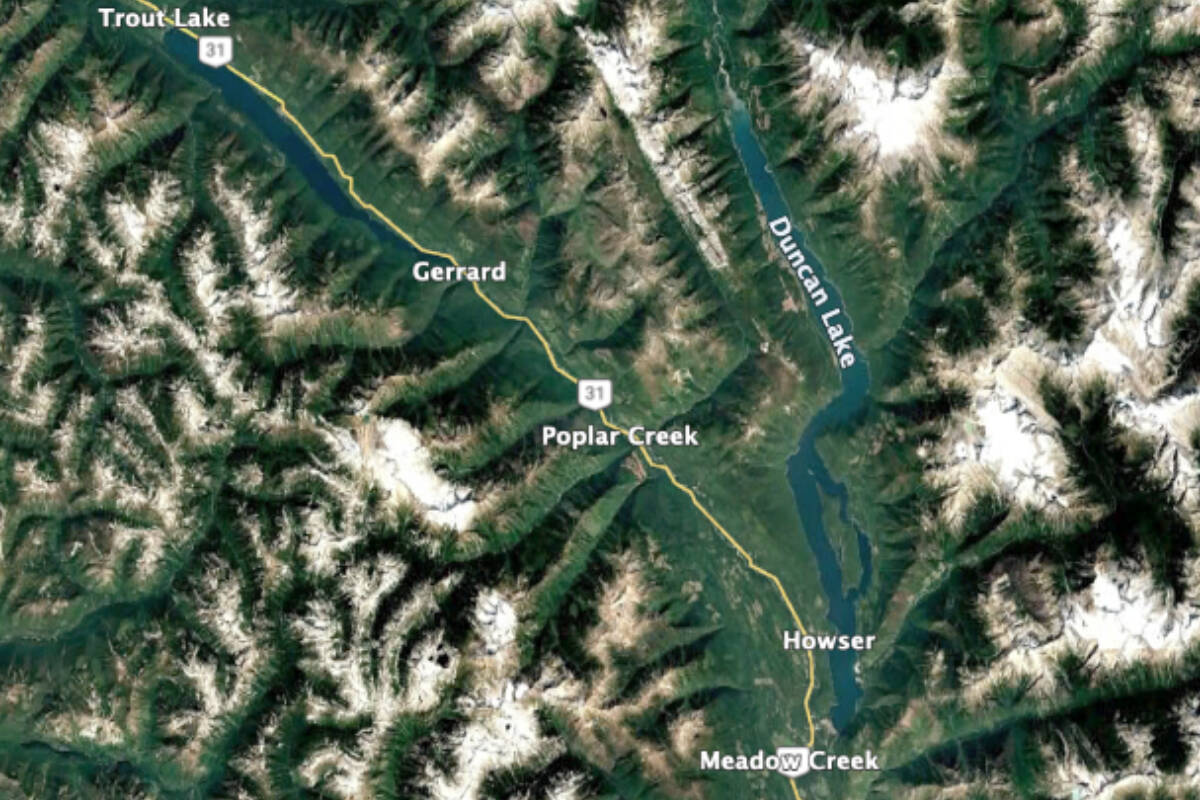
Residents who rely on the highway are circulating a petition that calls for a meeting with Kootenay Central MLA Anderson. Some want the road improved from Marblehead to Howser, others would see the entire 67 kilometres to Trout Lake paved.
Anderson said she had already heard from residents about the road and been in contact about it with the transportation ministry. She isn’t sure why the highway was never paved — that decision would have predated Anderson’s time in office by several decades — but said it is unlikely to be done at this point in time.
“I would say now with so many competing priorities in terms of our fiscal budget, every single type of maintenance and new paving and repairs, they’re done as soon as possible, but additional paving is going to be difficult in this fiscal climate. But I’d also be interested from residents if this is what they were looking for as well.”
Trower thinks an alternate, and cheaper, solution would be for YRB to start grading the highway twice a year to the bottom of the potholes before covering it with tar and gravel. The current grading is too shallow, which leads to vehicles spraying gravel and the potholes returning.
On March 23, three days after the Nelson Star visited the site, Anderson and residents said the road had been re-graded. Trower appreciated the work, but said it isn’t a long-term solution.
“This is what they do every year. They grade it a couple times, but that doesn’t get rid of the problem.”