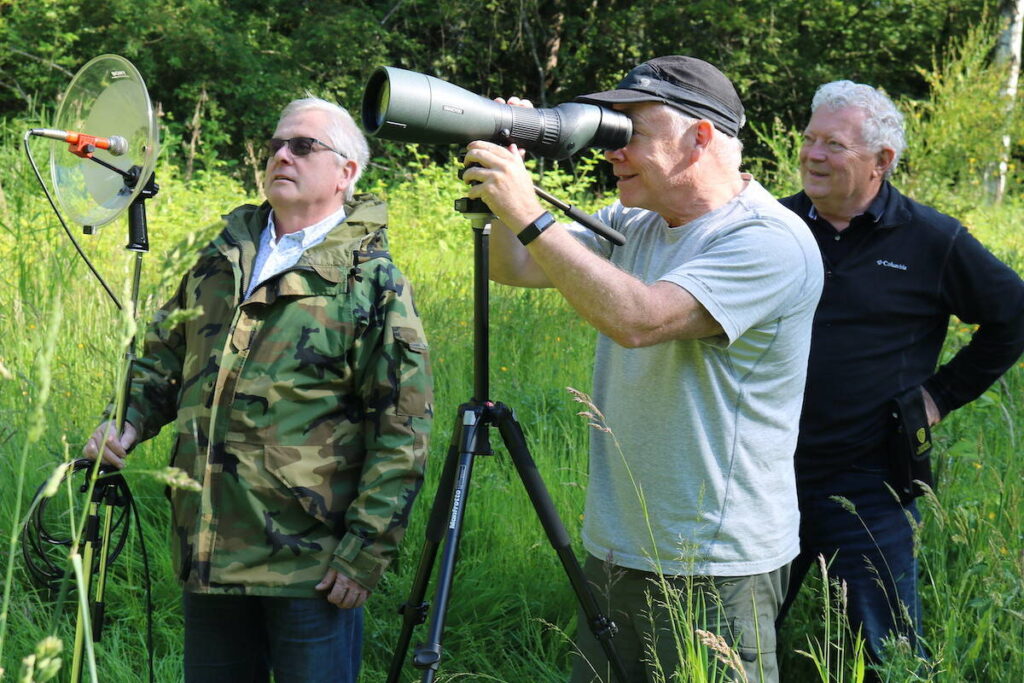
For years, three Greater Victoria men have been locked in the ultimate game of hide-and-seek with its most celebrated player and current reigning champion: Sasquatch.
Armed with trail cameras, night-vision gear and plenty of tenacity, Saanich residents Alex Solunac and Dave Hill, along with View Royal’s Stephen Gray, have spent countless hours combing Vancouver Island’s backcountry for the elusive creature many dismiss as little more than campfire lore.
But they’re not chasing the bipedal hairy giant for bragging rights. Nor are they seeking social media clicks with blurry snapshots or videos of the mythical beast peeking from its hiding place within the trees and shrubbery.
Solunac, Hill and Gray want answers.
Inspired by some of North America’s most renowned Sasquatch researchers – including Comox Valley’s John Bindernagel and Canadian journalist John Green – and driven by their own deep-seated fascination, the trio founded the Vancouver Island Sasquatch Society in 2018.
Dedicated to rigorous fieldwork and evidence collection, the citizen science group aims to move the Sasquatch conversation from myth toward fact.
“We’re in the process of discovery,” says Solunac.
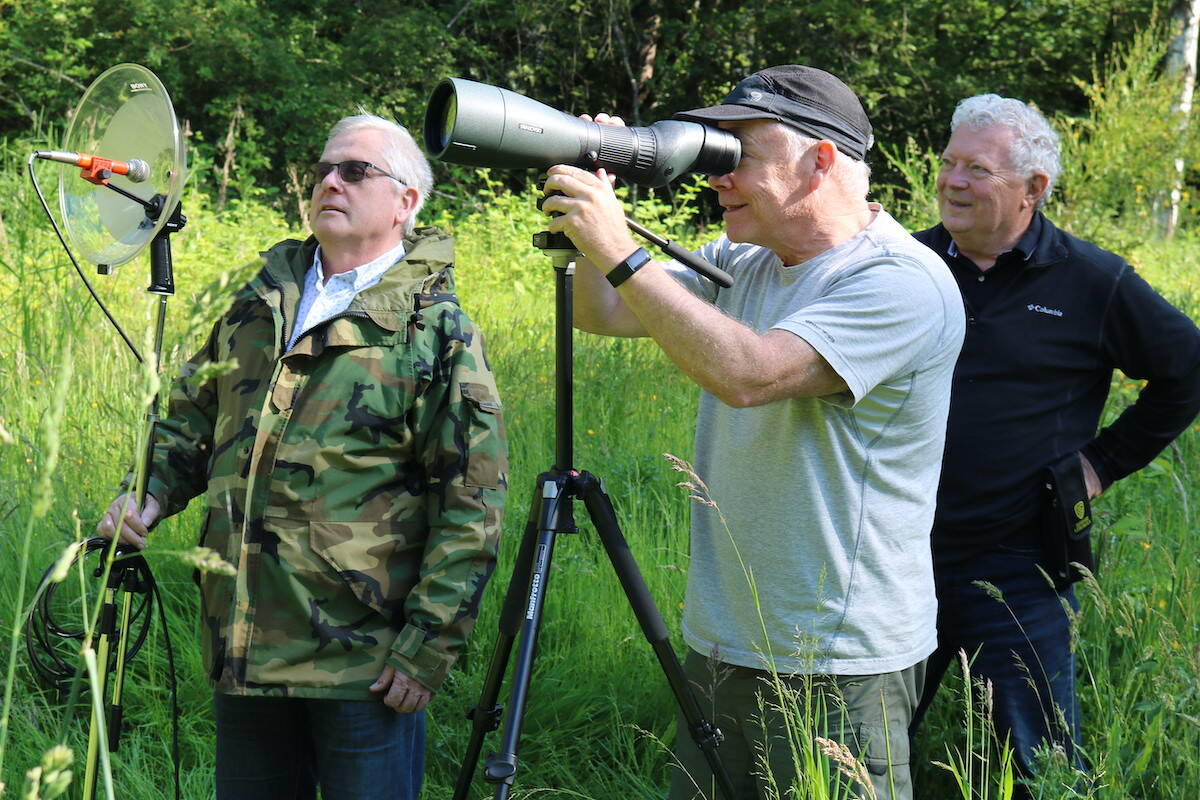
Alex Solunac, Dave Hill and Stephen Gray founded the Vancouver Island Sasquatch Society in 2018. (Ben Fenlon/Saanich News)
Each brings professional expertise that helps shape how the group approaches its field research.
Hill and Gray have both worked for the Canadian Forest Service, experience that helps them assess if a woodland area could realistically support a large, primate-like beast.
Hill analyzes what he calls the “calorie landscape,” evaluating if an area’s “food value” could sustain an animal the size of a Sasquatch. He also collects environmental DNA samples from watersheds, which can reveal what species are, or have been, present in the environment – even those that are rare or difficult to observe.
Botanist Gray focuses on vegetation ecology.
“I comment on what I think the Sasquatch are doing or what plants I think they would be eating,” says Gray. “Or I can tell if an area just doesn’t look right for Sasquatch and there’s nothing they’d be interested in.”
Solunac, a senior media analyst at the University of Victoria, has been involved in Sasquatch research since the ’80s. He brings decades of knowledge about the creature’s history – an interest that began around the age of six, after he first saw the famous 1967 Patterson-Gimlin footage of a supposed ‘Bigfoot’ in the Northern California wilds.
“I just could not understand how more adults weren’t concerned that there was a monster out in the woods,” he remembers.
Along the way, the trio has also developed additional field skills, including animal tracking, to strengthen their investigations.
Their commitment to approaching the controversial subject through a scientific lens is what they say sets them apart from fervent ‘believers’, content to accept the legend at face value from the comfort of their armchairs.
“The citizen science is out there, but there’s also the citizen belief system that you’re working against,” says Hill.
“Everybody loves the stories, but nobody likes sitting in a cold blind for a couple of days in the dark, rain and cold waiting for something that may never come along.”
“The hard part with belief is you don’t need to have any proof,” adds Solunac.
Over the years, movies, television and media coverage have helped build Sasquatch mythology, fuelling theories about the animal’s behaviour most ‘believers’ treat as fact.
Always hypercritical – with their “skepticles” on – the citizen scientists are not afraid to challenge those assumptions. In particular, Hill, who has earned a cheeky nickname from his peers.
“Some of the researchers call me ‘No Fun Dave’,” says Hill. “When I come up with these counterarguments to their evidence, it takes the fun out of it for them.”
Much of what passes for Sasquatch folklore often has a simple explanation, he says.
Sasquatch clicking rocks together as a method of communication?
“Yeah, that’s a click beetle,” says ‘No Fun Dave’. “There’s hundreds of different species here on the Island, and it’s just responding to what it thinks is a threat to its territory or a mating call.”
Mysterious oversized footprints? Often bears, or on the mainland grizzlies, whose overlapping paw prints can leave a much larger impression.
Trees upturned by Sasquatch? Sometimes the work of dwarf mistletoe, a parasitic plant that weakens and distorts tree growth.
And those mysterious “blood-curdling calls” echoing back from the woods in response to supposed Sasquatch calls blasted from a speaker?
‘No Fun Dave’ strikes again. “That’s most likely an owl,” he says.
“He’s great at parties,” jokes Solunac.
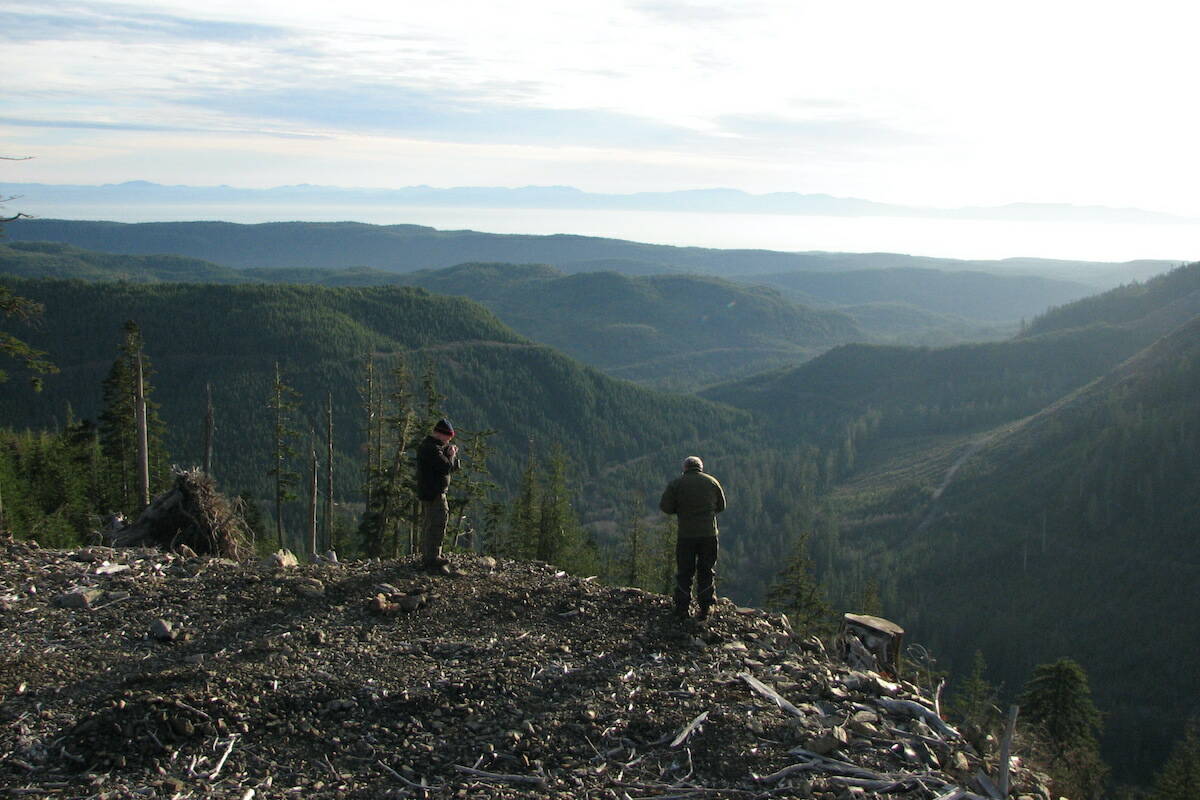
The Vancouver Island Sasquatch Society team survey the landscape of Camper Creek in the Cowichan Valley. (Courtesy of Alex Solunac)
Despite the uphill battle for credibility, the steady accumulation of evidence has strengthened their resolve, and their confidence that they may be tracking a potentially uncatalogued species.
“Based on the evidence, the probability that there is a living being out there that we haven’t discovered yet, I would say is good,” says Hill.
Yet for all the footprint casts, hair samples, eyewitness accounts and hours of audio recording, one crucial piece of evidence remains missing: a body.
Without a type specimen, samples collected in the field are unable to be definitively verified. Unidentifiable hairs and environmental DNA samples are often dismissed as contaminated.
“They’re not human, synthetic, or any other known North American animal,” says Solunac.
“But as we don’t have a body to match the samples to – it doesn’t exist,” adds Hill.
It was a similar story for gorillas, the threesome notes.
The species was widely considered a mythical creature by European explorers until the mid-19th century, when an American named Thomas Savage found gorilla bones in Liberia.
Mountain gorillas, too, were not officially recognized until 1902.
“Which, in the grand scheme of things, is not that long ago,” said Solunac.
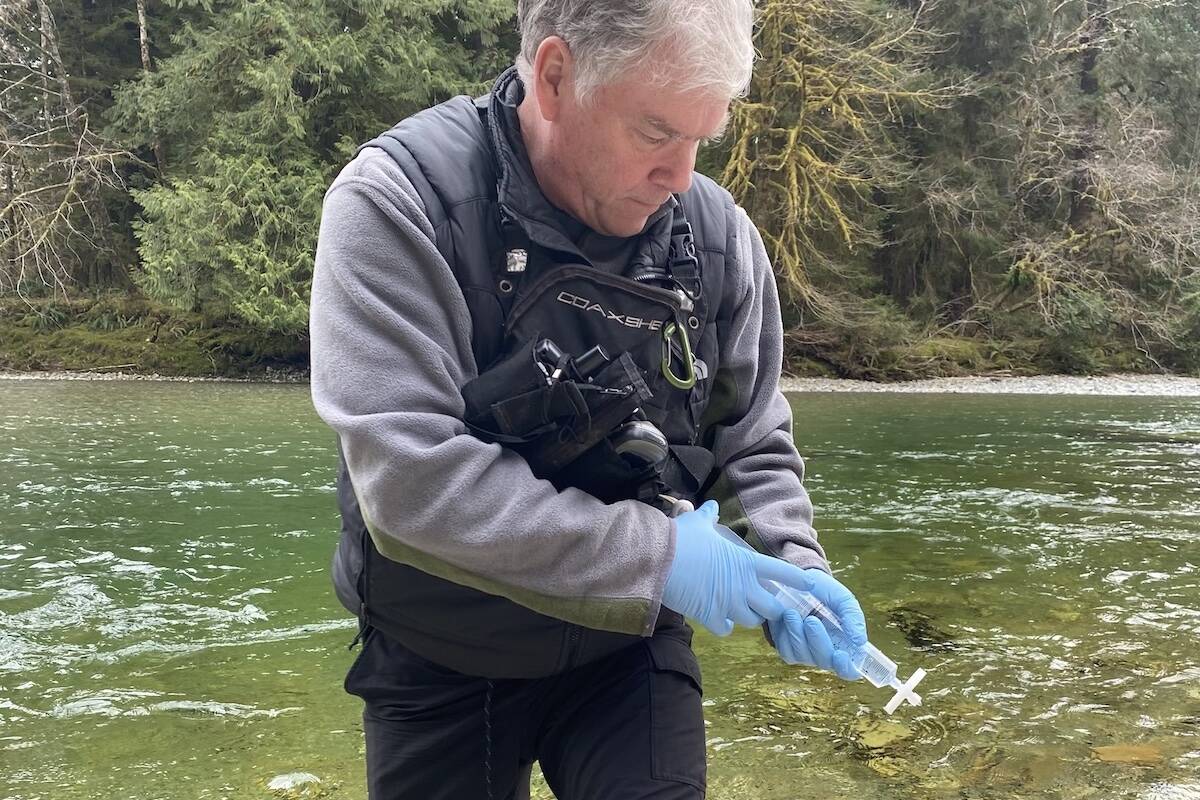
Dave Hill gathers environmental DNA samples from Klanawa River. (Courtesy of Alex Solunac)
Prior to the ‘discovery’ of gorillas, early reports of the giant apes were dismissed as tall tales, much like modern-day sightings of Sasquatch, which witnesses often describe as similar in stature to the primate.
Yet stories of Sasquatch have long existed in Indigenous culture across B.C., explains Solunac, long before news of the gorilla’s existence ever reached North America.
“First Nations Peoples were seeing this wild hairy man and reporting it in their stories and in their totems and carvings, way before any Europeans came here,” he adds.
But yet sightings are extremely rare, limited to remote, isolated areas.
Despite years of research, none of the three researchers has been lucky enough to spot a Sasquatch themselves.
Only one footprint has been documented by the team, found by Solunac and Hill after a 2009 sighting near Alberni Valley Regional Airport.
According to Solunac, a grandfather, his son and two grandkids were hiking to a secret fishing spot when they came face-to-face with a Sasquatch on a logging road after hearing “monkey chatter” noises.
“It looked at them and then just turned and walked through the woods,” said Solunac. “It was a good sighting – that’s four different sets of eyes looking at it.”
Investigating the area later, Solunac remembers finding unusual tracks on a steep, muddy incline leading down to a nearby river. The impressions were around 16 to 19 inches in length, deeper than others in the area and spaced farther apart.
Unfortunately, the prints lacked clear detail.
“But you could see that something with a heel had stepped down, and where there would have been toes,” said Solunac. “But then the gravel and the dirt had gone down into them, so they weren’t really castable.”
The team has followed up on many other reports across the Island, including sightings in the Sooke area and more recently in Central Saanich. In that case, a woman walking her dog said she had seen a Sasquatch in the woods near Alec Road.
Other Vancouver Island sightings have been documented by fellow Comox-based Sasquatch researcher Kerry Clausen-Kilmury, who has created an interactive map of sightings and news events from across Canada, some dating as far back as the mid-1800s.
According to the map, in 1982, three young boys playing in a patch of woods near Saanichton saw an unusual creature, standing 10 feet tall with hairy arms and legs.
Back in 1942, a 14-year-old boy said he was followed by a “gorilla-looking” creature, around seven feet tall, while he cut spruce in Central Saanich
And on the outskirts of Langford in 1975, three kids were chased out of the woods on Humpback Road by a large brown Sasquatch with a white patch on its leg. Thirteen years later, in 1988, near Luxton, a Sasquatch was spotted with a white patch on its leg, leading folks to believe it was the same one seen on Humpback Road.
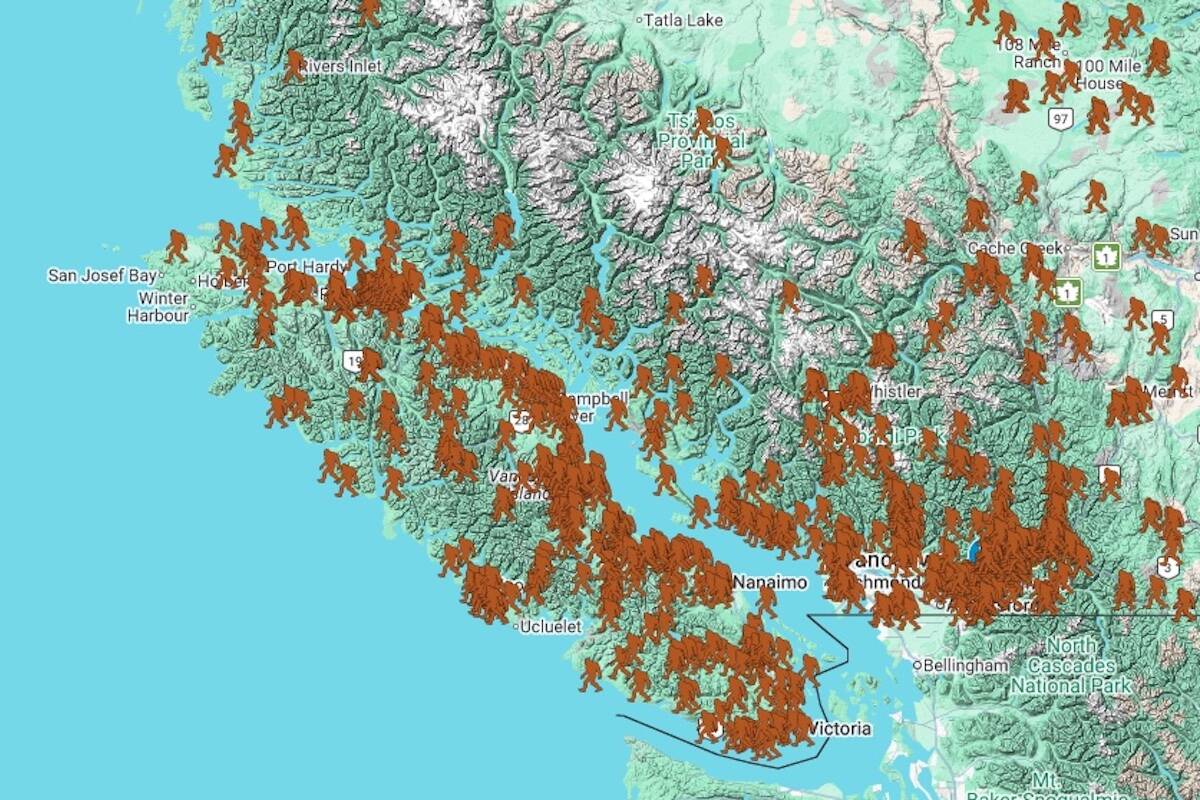
Sasquatch researcher Kerry Clausen-Kilmury, based in Comox, has created an interactive map of Sasquatch sightings and notable news stories across Canada, including multiple events on Vancouver Island. (Canada Sasquatch Map/Screenshot)
Still, eyewitness accounts alone are not enough for the Vancouver Island Sasquatch Society. Even photos and videos carry less weight than they once did, especially as advancements in AI technology help create more convincing hoaxes.
“We know there’s lots of people that are actively out there faking stuff,” said Solunac. “It really doesn’t move the process any further with a good video or photo now.”
Up against fictional anthologies, elaborate hoaxes, and over three million hectares of wilderness on Vancouver Island alone, the trio know they can’t work alone.
Even a single park can feel overwhelming. For East Sooke Regional Park, the group estimates they would need around 9,000 trail cams to cover every potential Sasquatch hiding spot.
Which is why Vancouver Island Sasquatch Society – who are also members of the Bigfoot Field Researchers Organization – organizes and leads field expeditions, sharing their knowledge and equipping like-minded citizen scientists with the tools needed to help gather credible evidence.
Unlike many Sasquatch outings that lean heavily on storytelling, the trio focuses on methodology. Participants are briefed on collecting evidence, equipment and how to document findings.
”It is basically like a four-day seminar in the field,” says Solunac.
Participants with a wide range of scientific backgrounds, including wildlife biologists and those interested in the study of relic hominoids, are encouraged to sign up for the group’s expeditions.
“Because we also want to learn from the people coming,” says Hill. “I’d love to have a dietician join us.”
Folks from across Canada, the United States and around the world have taken part in the group’s expeditions – most importantly, several participants from Vancouver Island have gone on to become members of the Bigfoot Field Researchers Organization.
“That’s the more important thing,” said Solunac. “Now we’ve got more people with eyes and ears out there with the background knowledge … and science-based backgrounds.”
As more people join the search, what would happen if convincing evidence was finally found?
“I’ve often thought a lot about this,” says Solunac. “I think all of us have.”
He admits he’s conflicted. Definitive proof could bring consequences as well as answers, worries Solunac.
“You’re going to have a lot of billionaires after it,” he says. “I’m sure Elon Musk would want one for his private zoo or whatever.”
He also fears the creature would quickly become a target for hunters seeking fame and fortune.
“That’s not the end game that I’d want for this animal at all,” he adds.
Perhaps for Solunac, Hill and Gray, the real end game isn’t proving Sasquatch to the world, but locking eyes on the beast themselves. Would that be enough to make them ‘believe’ and finally end their long-running game of hide-and-seek with a quiet “found you”?
Solunac says no, he already believes in the evidence, which supports the theory that there is something out there in the wilderness.
“If something is making big physical footprints out there, we’d like to find out what it is,” adds Hill. “And if it turns out that it’s not a Sasquatch as we know it, then that’s great too.
“But let’s figure it out.”
Do you have something to add to this story, or something else we should report on? Email: ben.fenlon@blackpress.ca.
<!– iCh jrfsPQZF –>