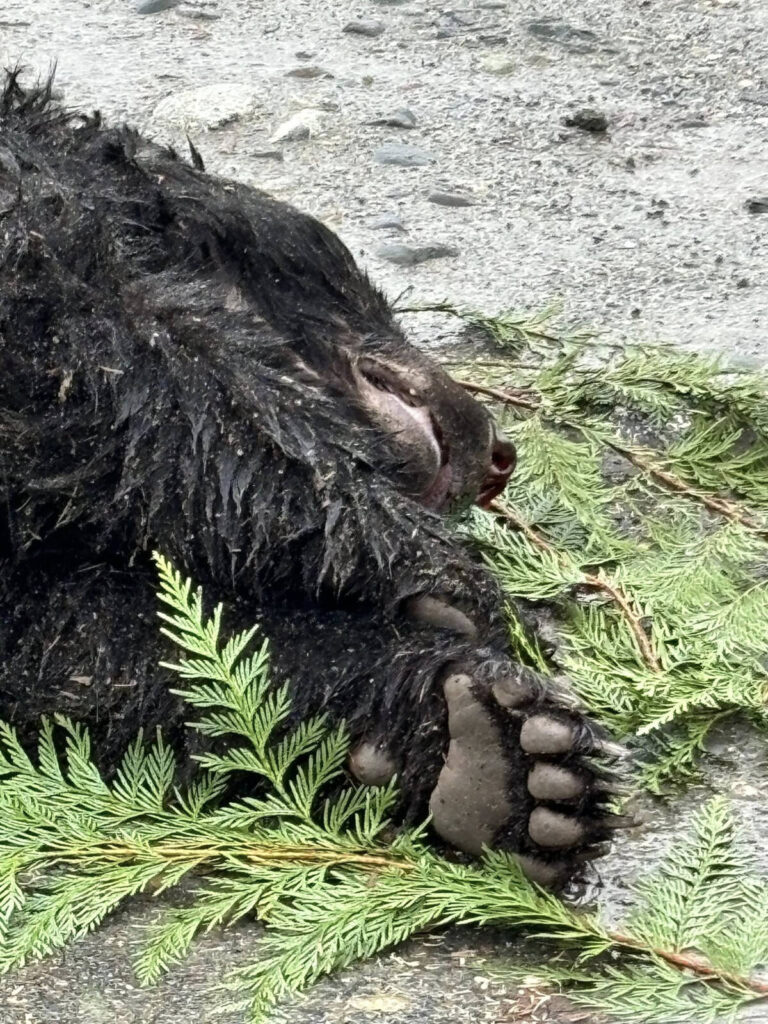
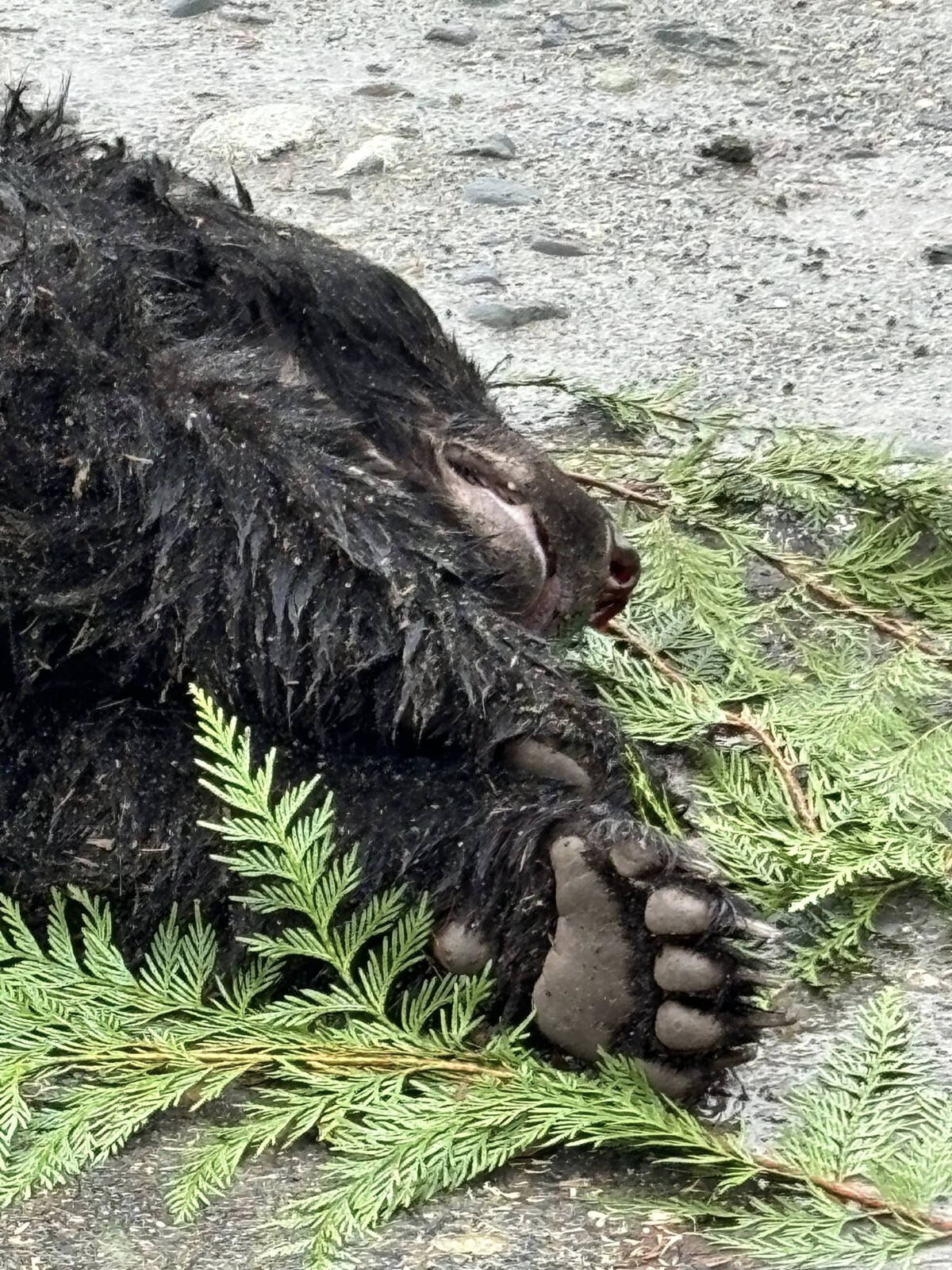
A black bear stretches, head down and body twisted, across a patch of gravel not far from the main road.
The sow is clearly dead, with her massive paws awkwardly where she lay after making her way from the road where a vehicle likely caused the fatal damage.
When Lani Ranger stopped at the forestry road entrance near what locals call the blueberry flats – well outside Sooke near Shirley Delicious – “there were no cars, just this stunning bear.”
She’d been enjoying a cozy Sunday morning in bed when an ad popped up – action figures perfect for 16-month-old grandson Bear – that meant a drive out from her Gordon Beach home to Living the Dream Farm. On the way out, she mentally tracked a group of cars stopped in the area.
One her way home, she checked it out.
“It’s a pretty big, wide entranceway, and she was just basically 20 feet in, off the road,” Ranger said.
The American black bear is the most common in Canada, and B.C. boasts the highest population with an estimated 120,000 to 150,000 in a variety of shades from the Kermode cream to the deep, dark namesake. Omnivorous animals, 80 per cent of the black bear diet is vegetation, and while most active April to November, the Island’s mild climate keeps them out sourcing food well into winter before settling into dens.
A five-year transplant from Ontario to the coast of B.C., cougars, bears and whales are part of everyday life now for Ranger.
The bear’s death sent her into tears, while her husband stood more stoic.
Through the sobs, Ranger’s mind raced, through what should and could be done to honour the bear, which appeared to be a fairly young female that hadn’t yet had cubs.
She called a friend who works for T’Sou-ke Nation to find out if they or the Pacheedaht might want the body. The answer was complicated, but ultimately neither had the capacity for the carcass.
Black bears account for 14,000 to 25,000 calls each year to the Conservation Officer Service. When one is found dead on the road from an apparent injury, it’s usually taken care of by maintenance crews. If it appears shot or otherwise poached, the COS wants to know about it through its 24/7 phone line 1-877-952-RAPP or online. Otherwise, the carcass is left to local maintenance. In this case, the bear lay on forestry-leased land.
That company was informed.
But Ranger couldn’t just leave the bear as a roadside spectacle.
“I’ve learned in the last five years that whatever is happening in our back woods and forestry land and Crown land in the back can be kind of nefarious sometimes. We’ve seen some weird stuff,” Ranger said. “I thought, ‘This girl is not going to be taken and harvested, and I’m not leaving until she’s picked up’.”
The friend from T’Sou-ke came out and brought sage.
“It’s always magic when she and I are together,” Ranger said. And this day proved no different as the duo burned sage and cut cedar boughs.
“In the pouring torrential downpour, we had this ceremony where we offered up asemaa, which is tobacco, then we put cedar around her.”
Ranger’s husband Pete, an Ojibwe/Cree man, drove home to get his drum, then performed the Ojibwe song Anishinaabe-kwe (Anishinaabe woman).
“It was the most powerful thing.”
The bear didn’t have a lot of physical trauma, a head injury and some road rash. Ranger figures she walked to where she was found.
“Her journey to her final space was her own. That was significant. It felt like you could see that timeline,” Ranger said.
Through the day, folks came and went, and awkwardly stood and looked and talked and shared.
When Ranger finally went home, she put her thoughts down in words and shared some images online. It resonated with folks, who shared their own images and thoughts. Her post and others gathered “likes” and commentary – perpetuating the conversation about wildlife and humans.
“Whatever happened that day didn’t just happen there,” Ranger said. “It was supposed to continue on to help others see what we need to be doing with our bears, what we need to be doing with our wildlife.”
Did you know:
In coastal British Columbia, black bear dens tend to be under large-diameter trees, logs, and stumps and may even be found above ground.
Black bears have delayed embryo implantation, a process where mating occurs in early summer and the embryo only implants in the fall if the female has sufficient fat reserves to nurse her young over the winter.
Females can give birth to up to five offspring, but twins are typical. Bear cubs are born in late January, blind and helpless, weighing 250 to 500 grams. They will nurse and grow to between 2 and 5 kg in size when they emerge in late April. Females will care for their young for about two years.
Black bears can live to over 30 years in age, but 15 to 20 is more typical. Mortality rate for cubs tends to hover around 50%. Young cubs are killed by other black bears, grizzly bears, wolves, coyotes and cougars. Adult black bears have few predators except for grizzly bears and wolves.
– WildSafe BC
<!– CrxaJsO –>